
Accountant, CPA, or CFO?
You’ve built a successful business, but somewhere between managing operations and planning for growth, your financial needs got more complex. What once felt manageable—reviewing reports, tracking expenses, preparing for tax season—has evolved into decisions that carry real weight. Cash flow matters more. Strategy matters more. And the cost of getting it wrong is higher than it used to be.
The question is no longer whether you need financial support. It’s whether you have the right level of financial expertise guiding your business forward.
Accountant, CPA or CFO: Understanding Why the Difference Matters
One of the biggest mistakes growing businesses make is assuming these roles are interchangeable. They’re not.
Each one serves a distinct purpose, and when one is missing—or stretched too far—gaps begin to form. Those gaps don’t always show up immediately, but over time they lead to missed opportunities, tax inefficiencies, and decisions made without full visibility.
Businesses that scale successfully tend to recognize this early and align their financial support accordingly.

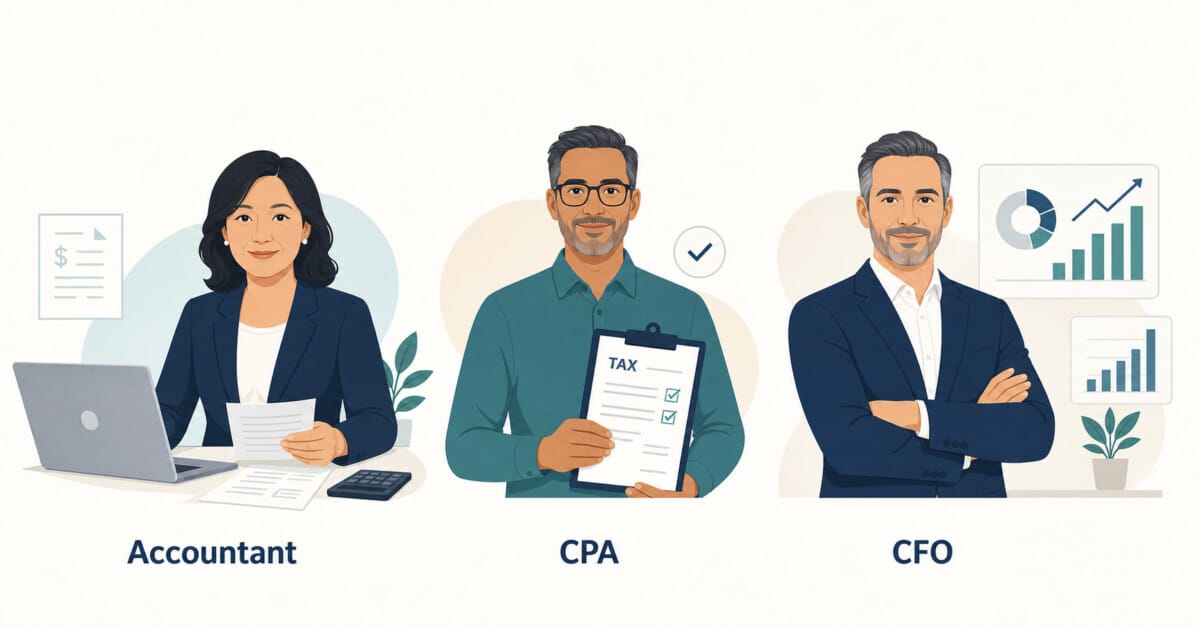
Accounting Services: The Foundation of Financial Clarity
At a higher level, accounting is about more than recording transactions—it’s about maintaining a clear, structured financial picture of your business.
An accountant ensures your financial data is organized, accurate, and consistently maintained. They manage reconciliations, oversee reporting, and create the structure that allows leadership to understand what’s truly happening behind the numbers. For growing businesses, this becomes critical.
When transaction volume increases and operations expand, even small inconsistencies can distort reporting. If your internal team is spending too much time trying to piece together financials—or questioning whether reports are reliable—you’re operating with limited visibility.
This is often where The Expert Accountant steps in, helping businesses establish clean, dependable financial systems that leadership can trust when making decisions.
Without that clarity, everything else—tax planning, forecasting, and strategy—becomes harder and far less effective.

CPA Services: Where Compliance Meets Strategy
As your business grows, your tax situation becomes more complex. Operating across multiple states, managing assets, adjusting entity structure, or preparing for outside funding introduces new layers of responsibility. At this stage, tax preparation alone is no longer enough.
A CPA brings strategy into the equation. They help you understand not just what you owe, but how to position your business in a way that minimizes liability and supports long-term growth. The Expert Accountant integrates CPA services into a broader financial strategy, shifting businesses away from reactive tax filing and toward proactive planning. The difference can be significant.
Strategic tax planning often saves businesses tens of thousands of dollars annually—money that stays in the business instead of being lost to avoidable tax exposure.

CFO Services: Financial Leadership for High-Stakes Decisions
There comes a point when accurate financials and strong tax strategy still aren’t enough. You’re making bigger decisions now—expansion, hiring at scale, capital investments, or preparing for acquisition. These decisions require more than historical reports. They require forward-looking insight.
A CFO provides that perspective. When businesses begin asking questions about runway, profitability under different scenarios, or the financial impact of major decisions, The Expert Accountant often introduces outsourced CFO advisory as the next step. This allows leadership to move forward with clarity, supported by forecasting, modeling, and strategic guidance.
At this level, financial support shifts into financial leadership. And that shift changes how decisions are made.
When Does Your Business Need an Accountant, CPA or CFO?
The transition between accounting, CPA or CFO services doesn’t happen all at once. It happens in stages—and recognizing those stages early can make a significant difference.
If your financial reporting lacks consistency or clarity, accounting support becomes essential. At this level, accuracy and structure create the foundation needed for everything that follows.
As tax complexity increases or your business structure evolves, CPA services play a larger role. The Expert Accountant works with businesses during this phase to introduce proactive tax strategy, helping leadership make decisions with a full understanding of their financial impact.
When your business moves into larger, more complex decisions, you may find that reporting alone isn’t enough. Questions around growth, investment, and long-term planning require CFO-level insight—guidance that looks ahead instead of behind. Each stage builds on the one before it.
Why Outsourced Financial Services Make Sense for Growing Businesses
Building a full in-house financial team at every level isn’t always practical. An experienced CFO alone can command $150,000 to $250,000 or more annually. For many businesses, that level of cost doesn’t match how often that expertise is needed.
Outsourced services provide a more flexible solution.
You gain access to experienced professionals across accounting, CPA, and CFO roles—without carrying full-time salaries. The Expert Accountant structures these services so businesses receive the right level of support at the right time, allowing leadership to focus on growth instead of staffing overhead. It’s not about replacing internal teams. It’s about strengthening them.

The Advantage of an Integrated Financial Approach
Many businesses build their financial support in pieces. An accountant managing reports. A CPA handling taxes. Occasional outside input when needed. Individually, each role may perform well. But without alignment, important details can be missed. Strategy and execution become disconnected.
The Expert Accountant approaches this differently by integrating accounting, tax strategy, and financial planning into a unified system. When these functions work together, information flows more efficiently and decisions are made with greater confidence. Instead of reacting to financial challenges, businesses begin anticipating them.
Getting the Right Financial Support for Your Next Stage
Your business doesn’t stay the same—and your financial support shouldn’t either. What worked when your business was smaller may now be limiting your ability to grow. The key is recognizing when it’s time to move from foundational support to more strategic guidance.
Understanding whether you need an Accountant, CPA or CFO isn’t about checking boxes. It’s about aligning your financial expertise with the level of decisions you’re making.
If your business is reaching a point where financial clarity, tax strategy, or forward planning feels critical, it’s worth taking a closer look at whether your current support structure is keeping up.
Take the Next Step
The Expert Accountant works with growing businesses to provide the right level of financial expertise at every stage—from structured accounting to advanced tax strategy and CFO-level guidance.
If you’re unsure whether you need an Accountant, CPA or CFO, or if your business is ready for the next level of financial leadership, now is the time to start that conversation.
Because when your financial strategy aligns with your growth… your decisions become clearer, faster, and far more confident.